While southern Bali draws crowds to beach clubs and bustling commercial avenues, the eastern regency of Karangasem preserves a remarkably tranquil, timeless landscape. For travelers seeking genuine cultural heritage and unspoiled nature, the hidden gems east bali has to offer provide an unmatched escape. From the mist-draped terraced valleys of Sidemen to the walled, ancient settlement of Tenganan Pegringsingan, this region showcases Bali in its purest form.
Exploring these quieter corners reveals steep volcanic ridges, rushing river valleys, and community traditions that have endured for centuries. Unlike heavily developed resort enclaves, East Bali demands thoughtful route planning, an appreciation for rural topography, and realistic scheduling. A private day tour or custom transfer allows visitors to absorb the scenery without the stress of navigating winding highland roads.
Whether planning a dedicated day excursion from Ubud or establishing a peaceful base amidst rural paddies, this comprehensive guide details the premier hidden gems east bali conceals. Learn what each destination offers, how much visits realistically cost, how to organize a seamless day route, and practical local tips for a memorable journey.
TL;DR — Hidden Gems East Bali at a Glance
- Premier highlights: Sidemen Valley rice terraces, Tenganan Pegringsingan Bali Aga village, Gembleng Waterfall rock pools, and Bukit Cinta sunrise vista.
- Best season: Dry season from April to October, delivering crisp morning skies and majestic, clear views of Mount Agung.
- Typical entrance costs: Sidemen rice terraces are free to explore; Tenganan entrance is an entry donation of IDR 20,000–50,000 per person; Gembleng Waterfall donation is IDR 20,000–30,000.
- Drive duration: Approximately 75 to 90 minutes from Ubud; 2 to 2.5 hours from Seminyak, Canggu, or Sanur.
- Transportation recommendation: Hire a reliable Bali private car charter. Ride-hailing applications such as Grab and Gojek do not operate reliably for pick-ups in rural Karangasem.
- Recommended combination: Pair Sidemen and Tenganan with iconic regional landmarks via a curated East Bali Tour or an extended 7-day Bali itinerary.
Why Hidden Gems East Bali Are the Island’s Most Authentic Region
East Bali, primarily encompassed within Karangasem regency, presents a dramatic geological and cultural contrast to the rest of the island. Dominated by the sacred silhouette of Mount Agung (Gunung Agung), the land cascades from rugged volcanic peaks down through fertile river gorges into the tranquil Lombok Strait. Because major expressway development stopped short of this eastern frontier, Karangasem retains its pastoral serenity and authentic communal rhythm.
Travelers choosing to venture east encounter living traditions rather than staged performances. In villages like Tenganan, pre-Hindu Bali Aga customs continue largely unchanged, governed by customary laws established over a millennium ago. Meanwhile, agricultural valleys such as Sidemen continue to operate under the ancient subak cooperative irrigation system, recognized by UNESCO for its spiritual and communal equity.
Furthermore, East Bali offers relief from heavy traffic congestion. Roads here wind past emerald river canyons, traditional bamboo bridges, and family-owned coconut groves. Visiting this quarter of the island allows travelers to experience authentic Balinese hospitality, sample home-style culinary specialties, and marvel at panoramic vistas that inspired classic travel literature of the early twentieth century.
Sidemen Valley: Emerald Rice Terraces, River Walks & Mount Agung Views
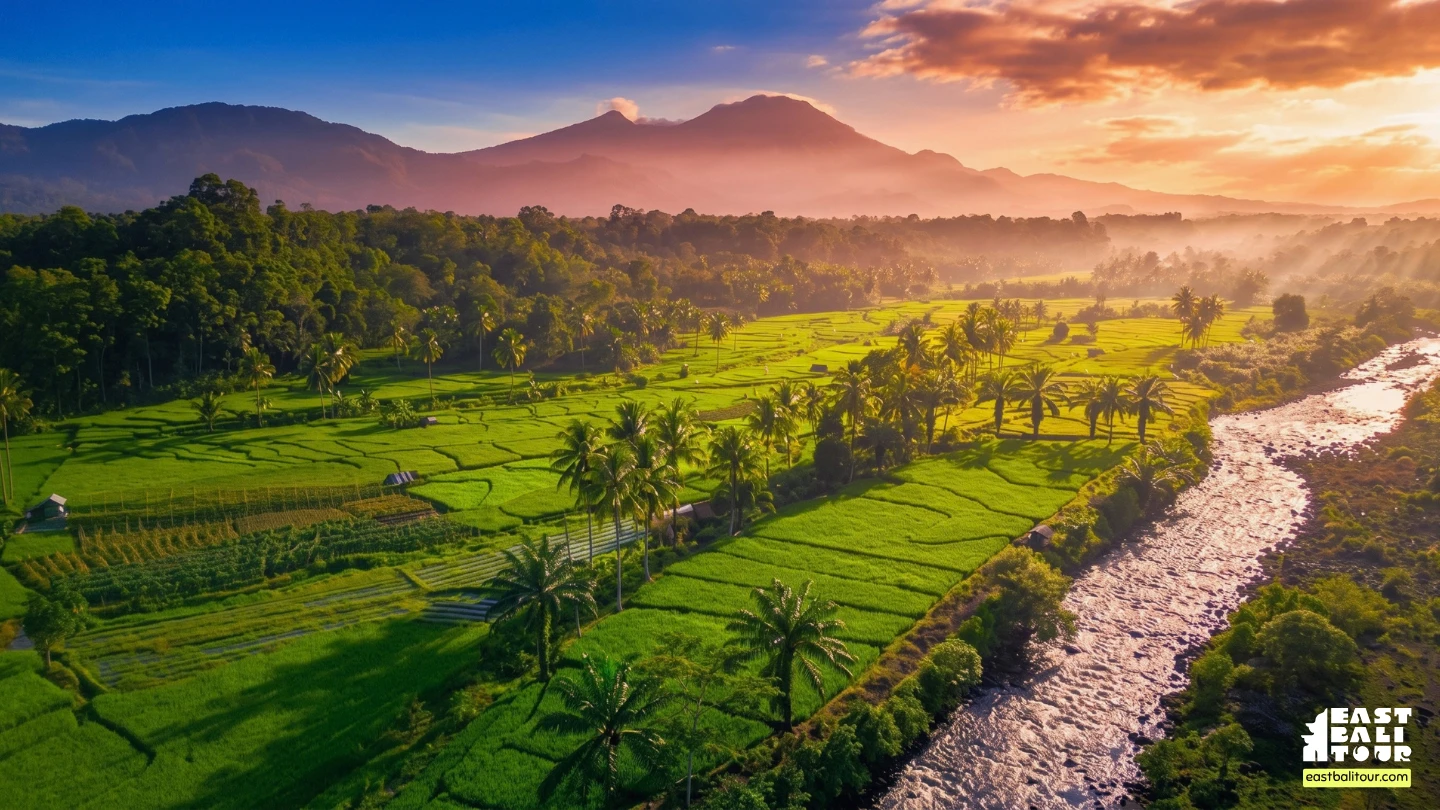
Nestled in a lush river basin along the Unda River system, Sidemen Valley is widely regarded as one of Bali’s most picturesque rural destinations. Often compared to Ubud as it existed three decades ago, Sidemen is defined by towering emerald rice terraces, working agricultural hamlets, and sweeping views of Mount Agung rising sharply against the northern horizon.
🕐 Open: Accessible daily 24 hours (Daylight exploration 06:00–18:00 recommended)
🎫 Entry: Free access; local village donations or guided walk fees IDR 50,000–150,000 for escorted path treks
⏱ Recommended Visit: 2 to 4 hours (or overnight stay)
🚗 Drive Time: ±1 hour 15 minutes from Ubud; ±1 hour 45 minutes from Sanur
Unlike tourist centers where rice fields are heavily commercialized with swing attractions and photo props, Sidemen’s terraces are actively farmed for white, red, and aromatic black rice. Narrow dirt footpaths traverse the retaining dikes, allowing independent walkers or guided groups to wander between plantations of chili, cacao, clove, and tropical fruits.
Among Sidemen’s most charming landmarks is the historic Jembatan Kuning (Yellow Suspension Bridge), which spans the rushing river and connects local communities. Crossing this footbridge provides spectacular views upstream toward Mount Agung, with village women carrying market goods and local farmers tending water canals.

Traditional Warungs and Sidemen Dining
Dining in Sidemen emphasizes fresh, locally sourced ingredients. Modest family-run warungs sit along the ridge roads of Tabola and Tebola villages, offering outdoor seating with open-air terrace views. Travelers can savor classic Balinese dishes such as Ayam Betutu (slow-cooked spiced chicken), fresh river greens, and tempeh satay paired with fragrant sambal matah.
For visitors interested in artisanal crafts, Sidemen is also an established center for traditional Balinese textile production. Weaving cooperatives throughout the valley produce intricate Endek and Songket ceremonial fabrics using hand-operated wooden looms. Visiting a local weaving workshop provides direct insight into the patience and mathematical precision required to thread geometric motifs, offering an ethical way to purchase authentic souvenirs directly from village artisans.
Tenganan Pegringsingan: Ancient Bali Aga Culture & Double Ikat Weaving
Located in the rolling foothills roughly five kilometers inland from the coastal town of Candidasa, Tenganan Pegringsingan is one of the most culturally significant settlements in the Indonesian archipelago. The villagers are Bali Aga (original Balinese), descendants of the island’s indigenous inhabitants who predated the 14th-century Majapahit court migration from Java.
🕐 Open: Daily 08:00–18:00
🎫 Entry: Modest community donation (typically IDR 20,000–50,000 per visitor)
⏱ Recommended Visit: 1.5 to 2.5 hours
🚗 Drive Time: ±45 minutes from Sidemen; ±1 hour 45 minutes from Ubud
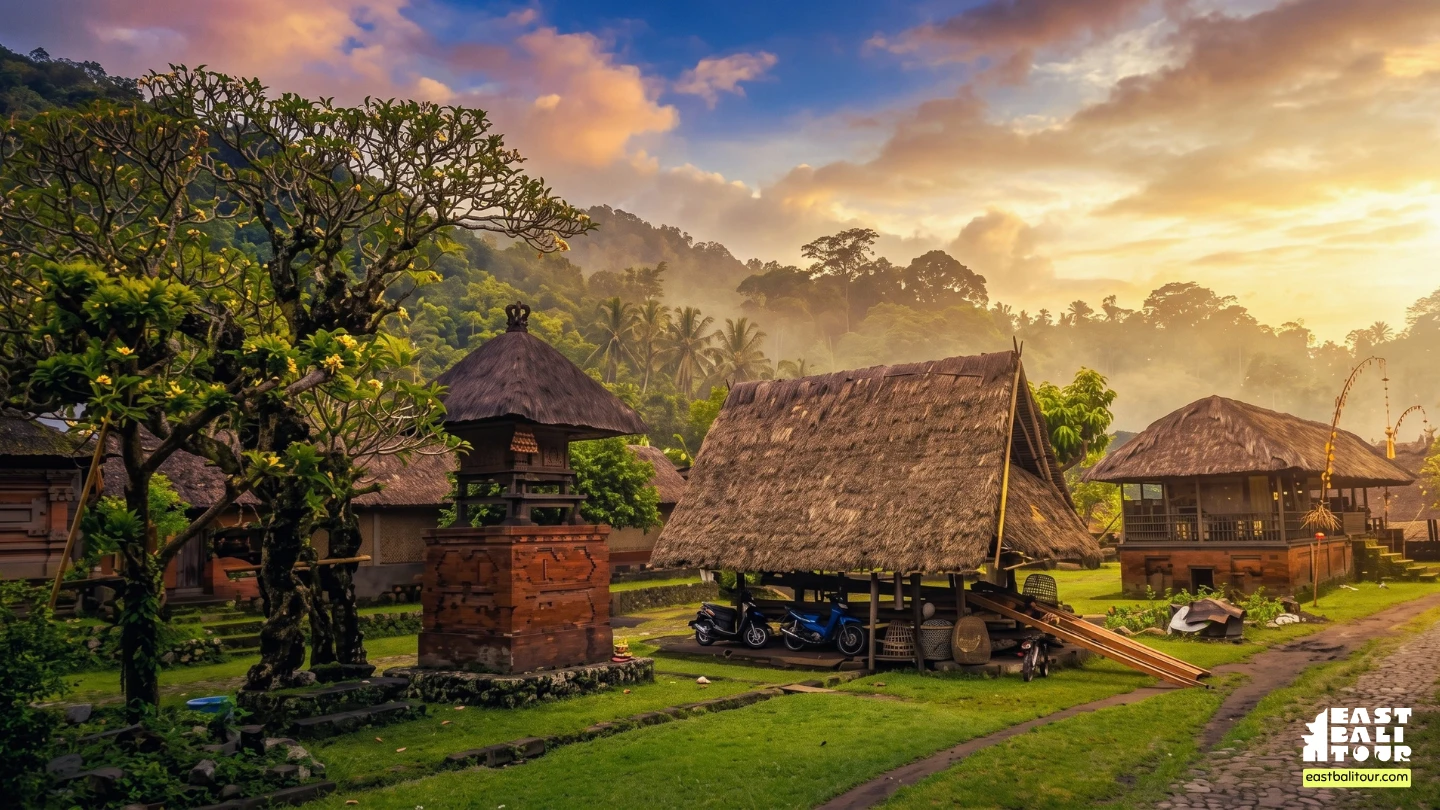
Tenganan’s architectural layout differs strikingly from conventional Balinese villages. The community is enclosed within protective perimeter walls entered through modest stone gates. Inside, the village is organized along wide, gently sloping stone-paved central avenues flanked by identical residential compounds. Communal longhouses (Bale Agung) and ceremonial pavilions occupy the public courtyards, where village elders meet to conduct customary governance under strict ancestral statutes known as Awig-Awig.
The World-Renowned Geringsing Double Ikat
Tenganan is internationally celebrated among textile scholars and collectors as the only place in Indonesia—and one of only three places in the world, alongside parts of India and Japan—that produces authentic Geringsing double ikat cloth. The name derives from gering (illness or misfortune) and sing (without), reflecting the sacred textile’s traditional role as a spiritual shield against sickness and negative metaphysical forces.
Unlike single ikat where either the warp or weft threads are tie-dyed, double ikat requires both the vertical warp and horizontal weft threads to be individually resist-dyed before weaving. The natural dyes are derived exclusively from organic forest materials: deep red from the root bark of the Morinda citrifolia tree, rich brown-black from candlenut and indigo, and warm cream from native cotton. Aligning these pre-dyed patterns on a traditional back-strap loom requires extraordinary skill and can take between one and five years to complete a single ceremonial cloth.
Travelers visiting Tenganan can walk quietly along the cobblestone lanes, view artisans working at hand looms on their front verandas, and observe other traditional village arts such as palm-leaf calendar engraving (Lontar) and intricate woven bamboo basketry (Ata).
Additional Hidden Gems Near Sidemen and Karangasem
While Sidemen and Tenganan serve as the twin anchors of an East Bali exploration, the surrounding terrain is rich with secondary natural wonders and serene cultural viewpoints. Incorporating one or two of these adjacent attractions creates a well-rounded and rewarding full-day itinerary.
1. Gembleng Waterfall (Air Terjun Gembleng)
Situated just twenty minutes south of Sidemen Valley, Gembleng Waterfall has gained recognition among independent travelers for its unique natural infinity pools. Rather than a singular towering plunge, water cascades through a series of natural stone rock basins perched high on a forested ridge.
🕐 Open: Daily 07:00–18:00
🎫 Entry: Community donation (IDR 20,000–30,000 per person)
⏱ Recommended Visit: 1 to 1.5 hours
🚗 From Sidemen: ±20 minutes drive
A short climb up well-maintained concrete steps leads to the upper tiers. Visitors can submerge in cool spring water while admiring sweeping panoramic vistas across the jungle canopy and distant rice fields below. Morning visits between 08:00 and 10:00 ensure quiet surroundings and optimal photographic light.

2. Bukit Cinta Sunrise Viewpoint
Located near Abang along the road toward Amed, Bukit Cinta (Love Hill) is one of Bali’s most magnificent sunrise viewpoints. An open hillside meadow provides unobstructed sightlines across rolling rice fields, swaying coconut palms, and the majestic northern face of Mount Agung. Early morning mist gathers in the valley below, creating an ethereal landscape as the rising sun casts golden rays across the slopes.

3. Lahangan Sweet
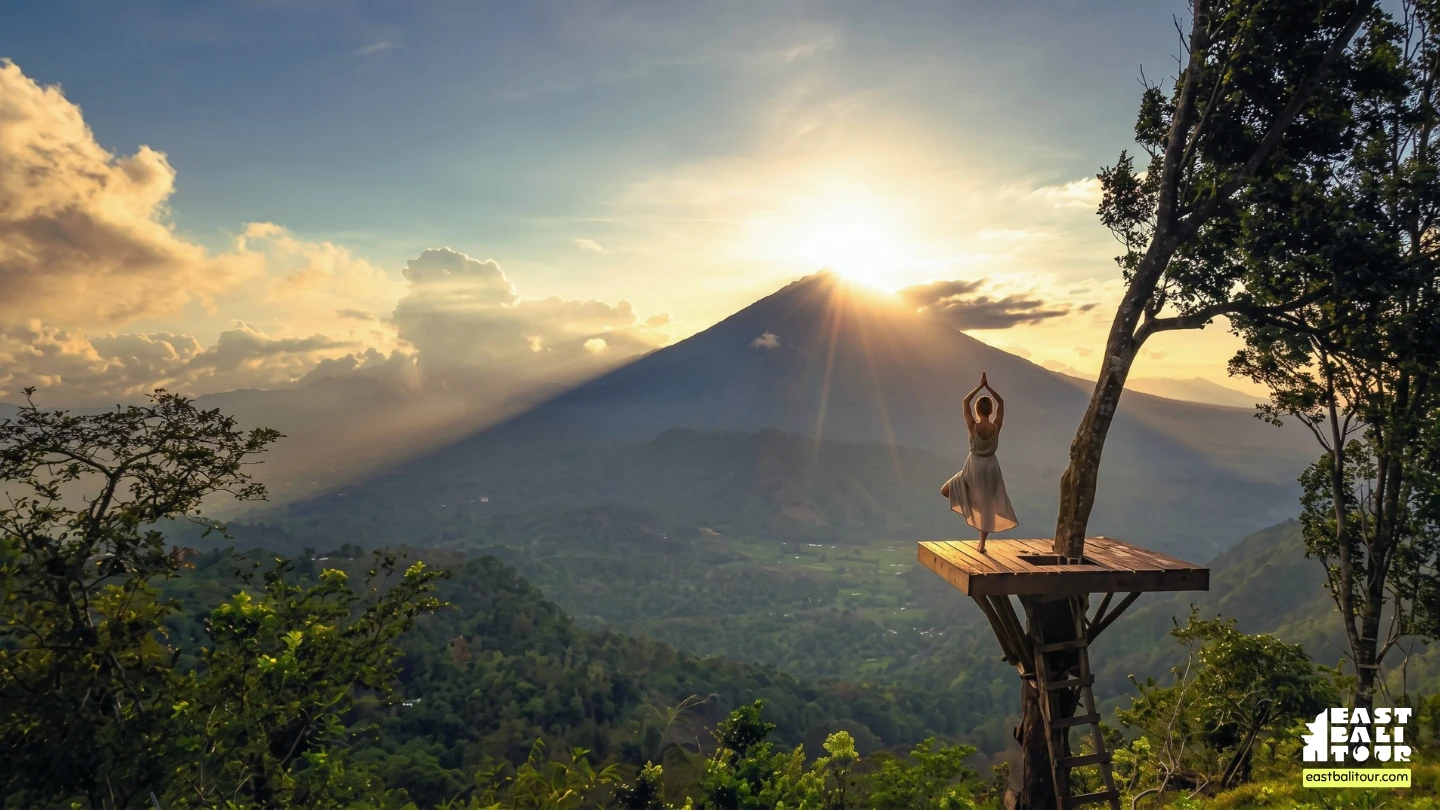
Perched high on a mountain ridge in Karangasem, Lahangan Sweet features rustic wooden platforms built into aged trees overlooking Mount Agung and the eastern ocean. Accessible by a short walk or local 4×4 shuttle from the parking base, it offers one of the most dramatic high-altitude vistas on the island, especially during early morning and late afternoon.
4. Tirta Gangga Royal Water Garden
Constructed in 1946 by the final King of Karangasem, Tirta Gangga Water Palace harmoniously blends traditional Balinese and European architectural styles. Ornate stepping stones wind through freshwater ponds filled with vibrant golden koi, surrounded by multi-tiered fountain towers and sculptured garden paths. Pairing Tirta Gangga with Sidemen and Tenganan provides an enriching balance of natural landscape, indigenous heritage, and royal architecture.

East Bali Day Trip Routes & Logical Route Sequencing
Because roads in eastern Bali wind through mountainous topography and river valleys, sequencing destinations geographically is critical to avoid unnecessary transit hours. Travelers often make the mistake of crisscrossing mountain passes, turning what should be a leisurely excursion into a tiring day on the road.
When organizing an excursion, take into account local weather patterns: mountain valleys like Sidemen and Mount Agung’s slopes often gather afternoon rain clouds between October and March. Beginning your tour early in the morning ensures clear visibility, cooler temperatures, and quiet roads.
Route Option 1: The Cultural & Valley Loop (Ideal from Ubud or Sanur)
This route focuses entirely on scenic nature and living culture, maintaining a relaxed pace suitable for photography enthusiasts and couples:
- 07:30 AM: Depart hotel in Ubud or Sanur toward Sidemen Valley.
- 08:45 AM: Explore Sidemen rice terraces and stroll across Jembatan Kuning yellow bridge.
- 10:30 AM: Short drive to Gembleng Waterfall for a scenic dip in natural cliffside rock pools.
- 12:30 PM: Enjoy a relaxed lunch at a ridge-side warung in Tabola overlooking the terraces.
- 02:00 PM: Drive through Klungkung regency to Tenganan Pegringsingan Bali Aga village.
- 02:45 PM: Guided cultural walk through Tenganan to observe Geringsing double ikat weaving.
- 04:30 PM: Begin the comfortable return drive to your hotel.
East Bali Travel Costs: Real Budget Breakdown
Traveling through East Bali remains remarkably affordable compared to southern resort districts. Most cultural villages and natural sites rely on modest community donations or low-cost municipal tickets. Below is an itemized breakdown of realistic travel expenses for 2026.
| Expense Item | Typical Price (IDR) | Notes & Inclusions |
|---|---|---|
| Sidemen Rice Terraces Access | Free / IDR 10,000 | Public pathways are free; minor donation requested at certain scenic viewpoints. |
| Tenganan Pegringsingan Entry | IDR 20,000–50,000 | Community development donation paid in cash at the registration post. |
| Gembleng Waterfall Donation | IDR 20,000–30,000 | Supports trail maintenance, stair railings, and safety facilities. |
| Tirta Gangga Water Palace Ticket | IDR 75,000 | Per adult international visitor; fish food packets available for IDR 5,000. |
| Lunch at Local Warung / Restaurant | IDR 45,000–120,000 | Per person for a traditional main course, fresh fruit juice, or fresh young coconut. |
| Local Trekking Guide (Sidemen) | IDR 150,000–250,000 | Optional 2-hour guided walking tour of agricultural fields and local hamlets. |
| Full-Day Private Car Charter with Driver | IDR 550,000–650,000 | 10-hour charter covering private air-conditioned vehicle, professional driver, fuel, and parking fees. |
Sample 1-Day Itinerary: Sidemen & Tenganan Hidden Gems
The following full-day schedule illustrates how to structure a smooth, unhurried journey through East Bali’s hidden treasures without backtrack driving or unnecessary highway delays.
| Time | Activity & Program |
|---|---|
| 07:30 – 08:45 | Morning departure from hotel in Ubud or Sanur. Enjoy a scenic transit through Klungkung past rural hamlets and volcanic river gorges. |
| 08:45 – 10:15 | Arrive in Sidemen Valley. Stroll through the lush rice terraces, visit Jembatan Kuning yellow bridge, and capture unobstructed morning views of Mount Agung. |
| 10:30 – 11:45 | Visit Gembleng Waterfall. Climb the scenic hillside stairs and enjoy a refreshing soak in the natural infinity rock pools overlooking the jungle valley. |
| 12:00 – 01:15 | Relax over a traditional Balinese lunch at a cliffside warung in Sidemen, sampling authentic local flavors with panoramic terrace panoramas. |
| 01:15 – 02:00 | Scenic drive eastward toward Candidasa foothills, connecting to the ancient walled village of Tenganan Pegringsingan. |
| 02:00 – 03:45 | Explore Tenganan Bali Aga village. Walk the cobblestone avenues, learn about ancestral customary statutes, and observe weavers crafting rare Geringsing double ikat textiles. |
| 04:00 – 05:30 | Relax in air-conditioned comfort during the return drive along the Kusamba coastal road back to your resort or hotel. |
Where to Stay in Sidemen: Accommodations for Every Style
While many visitors explore Sidemen on a day excursion, spending one or two nights provides an immersive rural retreat. Accommodations in the valley range from family-operated guest cottages to luxury eco-villas tucked amidst terraced paddies.
- Luxury Eco-Resorts & River Villas: Properties such as Wapa di Ume Sidemen and Samanvaya Bali offer world-class wellness facilities, infinity pools overlooking river gorges, and open-air bamboo dining pavilions. These retreats emphasize sustainable architecture and tranquil serenity.
- Boutique Heritage Lodges: Mid-range boutique hotels along Tebola ridge provide comfortable private villas featuring outdoor garden showers, plunge pools, and uninterrupted morning views of Mount Agung at accessible nightly rates.
- Authentic Village Homestays: For cultural immersion, local family homestays in central Sidemen offer clean, comfortable rooms, traditional Balinese home-cooked breakfasts, and personal hospitality that connects guests directly with village community life.

Best Time to Visit East Bali
East Bali experiences a tropical climate governed by distinct dry and wet monsoon cycles, monitored closely by Indonesia’s national meteorological agency (BMKG).
The optimal window for exploring Sidemen and Tenganan is during the dry season from April to October. During these months, humidity is moderate, rainfall is minimal, and skies remain clear throughout the morning—delivering crystal-clear vistas of Mount Agung and ideal hiking conditions along terrace pathways.
The rainy season runs from November through March, bringing frequent afternoon downpours and heavier cloud cover across highland ridges. While agricultural terraces turn a vibrant emerald green during this period, dirt trails can become slippery and river levels may rise rapidly. If traveling during the wet season, prioritize early morning departures between 06:30 and 08:00 AM to complete sightseeing before midday rain showers develop.
💡 Tip: Essential Advice for Exploring East Bali
- Carry Sufficient Cash (IDR): ATMs are scarce outside major towns like Klungkung and Amlapura. Small rural warungs, parking posts, and village donation booths accept cash only.
- Respect Village Etiquette: When visiting Tenganan Pegringsingan or walking through Sidemen hamlets, dress modestly. Ensure shoulders and knees are covered when entering temple compounds or sacred communal halls.
- Tread Mindfully on Subak Canals: Always stick to established walking paths on rice field retaining walls. Avoid stepping on irrigation canals or freshly planted rice seedlings.
- Footwear Matters: Wear sturdy walking shoes or sports sandals with good tread. Wet clay paths around terraces and waterfalls become slick after brief morning showers.
Practical Transportation & Why Self-Driving Is Challenging
Navigating East Bali requires careful consideration of road infrastructure. While primary coastal highways are paved and well maintained, regional roads connecting Sidemen, Gembleng Waterfall, and Tenganan are characterized by narrow lanes, sharp blind curves, steep mountain inclines, and occasional unpaved gravel stretches.
Renting a scooter or self-driving a car can be demanding for travelers unfamiliar with rural Indonesian road dynamics, where local traffic, stray livestock, and sudden weather shifts require constant vigilance. Furthermore, ride-hailing applications like Grab and Gojek do not maintain active fleets in Sidemen or Karangasem—meaning travelers relying on mobile apps frequently find themselves stranded without return transportation.
Hiring a dedicated private car charter with driver provides the safest, most flexible solution. A professional local driver handles navigation, negotiates highland parking, safeguards personal belongings while you explore, and adapts travel timing to suit weather and crowd conditions.
Ready to Explore East Bali’s Hidden Gems?
Plan your private Sidemen and Tenganan day trip with East Bali Tour. Enjoy a clean air-conditioned vehicle, dedicated local driver, transparent pricing, and complete itinerary flexibility.
How far is Sidemen Valley from Ubud and southern Bali?
The drive from central Ubud takes approximately 75 to 90 minutes (38 km). From southern hubs (Seminyak, Canggu, Kuta, Sanur, or Ngurah Rai International Airport), expect 2 to 2.5 hours depending on traffic.
Are the Sidemen rice terraces free to visit?
Yes. The terraces are active agricultural lands and free to explore via public walking paths. A few designated viewpoints or community-maintained trails may ask for a small upkeep donation (IDR 10,000–20,000).
What makes Tenganan Pegringsingan village unique?
Tenganan is an ancient Bali Aga (original Balinese) settlement predating the Majapahit era. It is famous for its fortified stone architecture, distinct customary laws, and as Indonesia’s only producer of sacred Geringsing double-ikat textiles.
Can Sidemen and Tenganan be visited together in one day?
Yes. They are roughly 45 minutes apart by car. A practical full-day route pairs a morning rice terrace walk in Sidemen with lunch and an afternoon cultural tour of Tenganan.
Do Grab and Gojek operate in Sidemen or Tenganan?
No. Ride-hailing apps do not operate fleets in rural East Bali. While drivers may drop you off from the south, booking a return ride is practically impossible. Hire a private driver for the entire day instead.
What is the dress code for Tenganan village?
Wear modest attire that covers your shoulders and knees. While full temple attire (sarong and sash) is not mandatory on the village main street, conservative dress is required to respect the Bali Aga community.
How much does authentic Geringsing double-ikat cost?
Because authentic Geringsing takes months to dye and weave, genuine heirloom pieces range from IDR 1,500,000 to well over IDR 15,000,000 depending on complexity and age. Smaller woven souvenirs and bookmarks start around IDR 100,000.
Is Gembleng Waterfall safe for swimming?
Gembleng features small natural rock pools suitable for wading and soaking rather than deep swimming. Rocks are slippery, and entry should be avoided during heavy rain due to rapid runoff and flash currents.
When is the best time for clear views of Mount Agung?
The dry season—specifically June through August—offers the clearest skies and lowest humidity. For the best views of Mount Agung, plan excursions between 6:00 AM and 9:00 AM before cloud cover rolls in.
How can I book a private day tour to East Bali?
You can reserve a private car charter directly via WhatsApp through local operators such as East Bali Tour. Charters include hotel pickup across South Bali or Ubud, a dedicated driver on standby, and flexible routing.